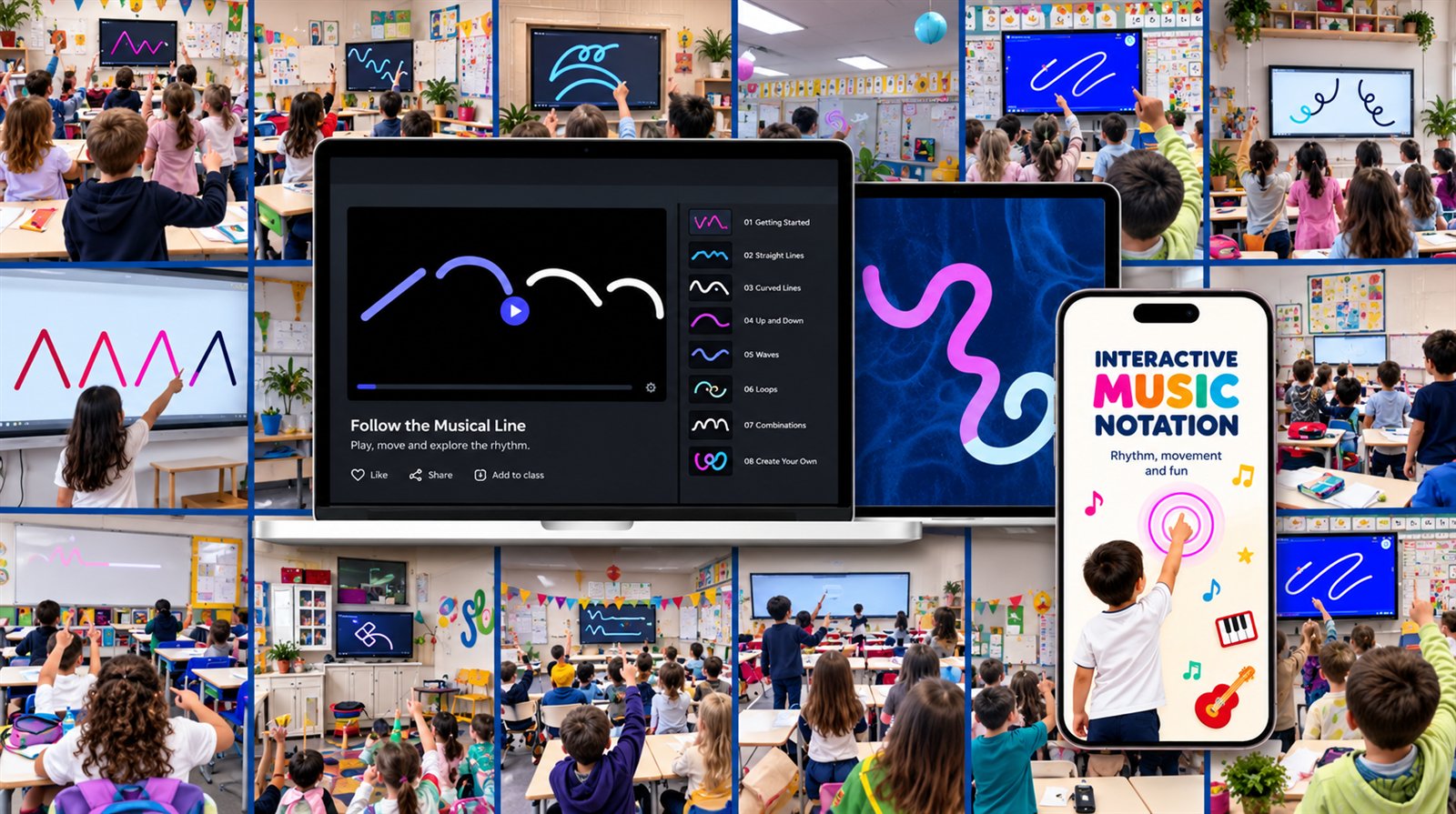
I'll be honest, I thought it'd be another YouTube thing. I've been using it after playtime for three weeks now: I put on Vivaldi's Spring and within two minutes all 28 of them are sat down without me saying a word.
The children in the video weren't dancing. They were training their attention.
It's called a musicogram: a coloured line that follows the music on screen. The child traces it in the air with a finger and, in 2 or 3 minutes, comes back calm and ready for the next task. The brain break that settles the class instead of winding it up. 25 videos ready to put on any screen.
Playtime is over. The class hasn't noticed.
Half of them are rocking on their chairs, the other half are staring out of the window. You ask for quiet once, twice, three times. Ten minutes go by before you can start, and by home time your voice has gone.
In the clinic it's the same: the child arrives wound up from the car and the first fifteen minutes of the session go on getting them to land.
And most brain breaks make it worse. Jumping and shouting along to a video is fun, but it leaves the class louder than before.
It isn't goodwill that's missing. It's a switch that brings everyone back to the same place, without raising your voice.
Press play
Put the video on the interactive whiteboard, the TV, a laptop or a phone. Nothing to print, nothing to prepare.
The child follows the line
A coloured line moves in time with the music. They trace it in the air with a finger, using big movements, standing or sitting.
In 2 or 3 minutes, they're ready
The body has moved, the eyes have focused and attention is free for the next task.

Every piece has its own line
From a simple movement for the youngest to a complex path with jumps, pauses and changes of direction.


Two minutes that work the brain on six fronts
Sustained attention
Following the line from the first note to the last, with no gap to drift off.
Visual tracking
The eyes follow a target in constant motion: the same skill children need to read and to copy from the board.
Coordination and motor planning
Arm, shoulder and trunk plan the movement before making it. It's the foundation of fine motor skills on paper.
Rhythm and active listening
Every change in the music changes the line. Children learn to listen with purpose: beat, tempo, silence.
Spatial awareness
Up, down, across and back again. Directions learnt with the whole body, the groundwork for handwriting and maths.
Self-regulation
The active pause resets the level of alertness. The restless child slows down, the daydreamer wakes up.
Made for people who work with children
Part of your planning, not an add-on. The activities link directly to two areas of the EYFS, Physical Development and Expressive Arts and Design, and to listening and responding to music in Key Stage 1. Easy to slot into your weekly plans without having to justify it.
Use it tomorrow morning
Choose your pack
Pay by card or PayPal on a secure page.
1 minuteGet your access by email
Your login arrives straight away. Sign in from any device.
instantlyPut on the first piece
Pick a level, press play and watch the class settle.
the same dayThe complete Interactive Musicogram
- 25 animated videos with the music built inReady to play, nothing to put together.
- A repertoire of great classicsBeethoven, Bach, Mozart, Tchaikovsky, Vivaldi, Brahms, Grieg, Bizet, Strauss, Chopin, Saint-Saëns and more.
- Lines at different levelsFrom a simple movement in nursery to the complex paths of Key Stage 2.
- On every screen, for lifeInteractive whiteboard, TV, laptop, tablet or phone. In the classroom, the clinic and at home. Lifetime access.
What people write under our posts


Teachers, therapists and families: comments left unprompted under our posts.
In the classroom, the clinic and at home
I use it at the start of sessions with children who come in unsettled. The pieces with pauses are great for working on waiting for your turn to talk, too.
For bilateral coordination it's brilliant. I have them trace with both hands together, then one at a time. I note it on the observation sheet and can see progress week to week.
Bought it for homework time. Before sitting down Oliver used to do three laps of the house. Now he puts the Hungarian Dance video on himself and then sits down on his own. His teacher asked me what it was called.
I work with the little ones in nursery and was worried it'd be too hard. They follow the first-level lines with their whole arm and giggle the whole way through. Now they ask for it.
I was a bit wary, £8.99 seemed too cheap to be any good. One of my pupils with ADHD now asks for "the line video" when he feels himself getting wound up. That's worth it for me.
I shared it with all six classes in the school. Each one uses it at a different time: one at morning drop-off, one before quiet time, another before handwriting.
As a musician I was sceptical, I've been drawing listening maps on paper for years. These are done properly: the line genuinely changes when the musical phrase changes. They've saved me hours of prep.
8 bonuses so you can use it from day one without thinking
Each one answers a question that comes up right after the first piece: when to use it, how to record it, what to tell the children.
Musical Pause Planner
Which piece to use at which point in the day, week by week.
Observation Sheets
Ready-made grids to record each child's attention, coordination and rhythm.
Listening Guide to the 25 Pieces
The short story behind each piece and what to tell the children before you press play.
Tracing Workbook
The lines on paper to trace over in pencil: from movement in the air to pre-writing.
Sound Detectives
Cards for recognising and telling sounds apart, training auditory discrimination.
Sound Bingo
Printable cards for listening games in groups, perfect for the whole class.
20 Transition Routines
The exact words to start and finish the activity without losing the class along the way.
Parents' Guide
Two pages to hand out to families so they can carry it on at home, before homework.
Start today, from £8.99
Musicogram Essential
Just the videos, to get started
- 25 Interactive Musicogram videos
- Instant access
Musicogram Complete
The videos plus everything you need to use them well
- 25 Interactive Musicogram videos
- Instant, lifetime access
- 🗓️ Musical Pause Planner
£8Free - 📋 Observation Sheets
£10Free - 🎼 Listening Guide to the 25 Pieces
£8Free - ✏️ Tracing Workbook
£12Free - 🔍 Sound Detectives
£8Free - 🎲 Sound Bingo
£8Free - 🔔 20 Transition Routines
£6Free - 🏠 Parents' Guide
£6Free
Card or PayPal · Secure payment
Try it with your children. The risk is on me.
You have 15 days to use it in your classroom or clinic. If you don't see the difference, just email me and I'll refund every penny, no questions and no forms to fill in. It covers both packs.
Before you decide
Do I get access straight away?
Yes. As soon as your payment is confirmed you'll get an email with your login to the area with all the videos.
What format is the material in?
The 25 musicograms are videos you watch online on any device. The bonuses in the complete pack are PDFs, ready to print or keep on a tablet.
Do I need any special equipment?
No. Any screen with sound will do: interactive whiteboard, TV, laptop, tablet, or even a phone for one child.
Does it work with a whole class or just one child?
Both. On the whiteboard the whole class does it together; in a clinic you use it one to one at the start of a session.
What age is it for?
Roughly 3 to 10. The lines are grouped by level, so you pick the right one for the children in front of you.
Do I need to read music?
No. The line does all the work: you press play and, if you like, join in with the children.
How long do I have access for?
For life. You pay once and the videos are yours.
What if I don't like it?
You have a 15-day guarantee. Email me and I'll refund you in full.
Two minutes of music. A child ready to go again.
25 videos you can put on today, from £8.99.
I want the Musicogram Instant access · 15-day guarantee